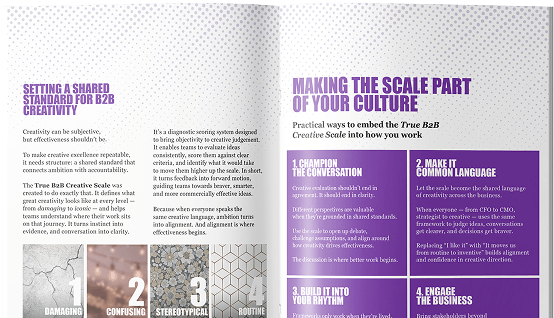
A shared standard for judging creativity, raising ambition, and driving creative effectiveness in B2B
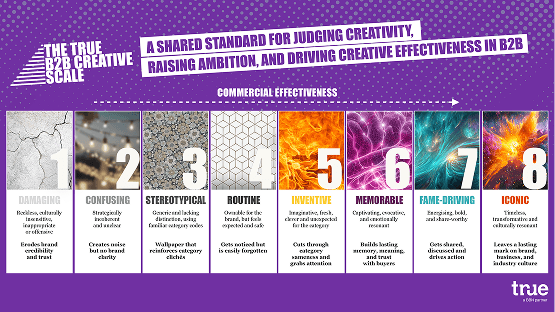

1
Damaging
Reckless, culturally insensitive, inappropriate or offensive
Erodes brand credibility and trust
Does this work undermine confidence in the brand or the category?
In B2B, every communication either builds or erodes trust — and trust is everything.
When work feels misleading, insensitive, or simply out of touch with its audience, it damages more than reputation; it casts doubt on the competence and integrity of the business behind it.
The consequences run deeper than a single campaign.
Buyers remember brands that overpromise, disrespect, or distort — and they share those impressions across teams, functions, and industries.
Reaction
“I don’t trust this brand — and I wouldn’t recommend them.”

2
Confusing
Strategically incoherent and unclear
Creates noise but no brand clarity
Does clarity cut through — or does complexity take over?
Clarity is a commercial advantage. Yet in B2B, it’s often the first casualty of complexity.
When too many messages compete for attention — product claims, proof points, rational logic — the human story gets lost. What should be clear and compelling becomes dense, tangled, and hard to follow.
Sometimes the issue isn’t just what’s being said, but how it’s expressed. When the creative idea complicates rather than clarifies, it draws attention away from the message instead of sharpening it.
Confusion doesn’t just make people disengage — it makes them doubt. Buyers under pressure to make the right choice don’t have time to decode unclear propositions. If they can’t easily explain your value to someone else, the idea hasn’t landed.
Reaction
“I don’t get it. What exactly are they trying to say?”

3
Stereotypical
Generic and lacking distinction, using familiar category codes
Wallpaper that reinforces category clichés
Could this belong to any brand in the category?
When B2B brands cling to the comfort of corporate sameness — the handshake visuals, the jargon headlines, the promise of “solutions that empower” — they become invisible.
Work that follows category convention reinforces the status quo rather than challenging it.
It may look professional, but it isn’t ownable or distinctive, and buyers tune out fast. In markets where differentiation drives margin, sounding like everyone else is the most expensive mistake you can make.
Having a different logo, brand colour, font or strapline doesn’t change that.
Reaction
“They look and sound like every other brand in the category.”

4
Routine
Ownable for the brand, but feels expected and safe
Gets noticed but is easily forgotten
Is this just meeting expectations — or moving them?
Routine work isn’t born from a lack of insight. The brand has a genuine point of view, a real and ownable truth. But somewhere between the brief and the execution, conviction gives way to caution.
The result is work that’s strategically sound and visually competent, but never surprising. It lands safely within the brand playbook without ever pushing it forward. It might generate polite recognition, but it rarely changes perceptions or drives memorability.
It’s predictable work that reinforces existing brand associations.
Reaction
“That was ok. It’s what I expected to see from that brand.”

5
Inventive
Imaginative, fresh, clever and unexpected for the category
Cuts through category sameness and grabs attention
Does this reframe something familiar in a way that makes buyers think again?
Inventive work is where intelligence meets imagination.
It finds fresh angles on truths buyers already understand, revealing them through sharper insight, better storytelling, or unexpected craft.
This kind of creativity doesn’t rely on gimmicks; it surprises because it’s smart.
Inventive ideas challenge category thinking just enough to make people stop, look twice, and lean in.
It’s the point where B2B work begins to earn attention, not just buy it.
Reaction
“That’s clever. It caught my attention. Really nicely done.”

6
Memorable
Captivating, evocative, and emotionally resonant
Builds lasting memory, meaning, and trust with buyers
Will this stay with decision-makers long after exposure?
True memorability isn’t built through repetition — it’s built through feeling.
But in B2B, “feeling” is often misunderstood. The emotions that build memory aren’t the ones that make people tear up — they’re the ones that light people up.
Joy, surprise, laughter, and awe — these are the feelings that spark attention, fuel sharing, and make brands feel alive in people’s minds.
Work at this level does something most B2B creativity never attempts — it makes people feel something real. Genuinely moved, surprised, or delighted. That feeling is what converts a single exposure into a lasting impression. The test is simple: would someone who saw this once still be able to describe it a week later?
People don’t remember what you tell them. They remember how you made them feel — and those feelings build reputation, preference, and long-term growth.
Reaction
“I still think about that campaign. It just landed differently.”

7
Fame-driving
Energising, bold, and share-worthy
Gets shared, celebrated, and talked about
Does this generate interest that no media plan could engineer?
Fame in B2B isn’t about noise, it’s about influence. It’s how brands shape the conversation, win attention, and lead markets forward.
Fame-driving ideas are bold enough to escape the boundaries of their target audience and category. They generate widespread earned media coverage and social sharing, spark conversation across leadership teams and decision-making units, and get talked about by people who were never meant to see them.
They turn a campaign into a company talking point — a symbol of confidence and progress that the whole market notices.
Reaction
“Everyone’s talking about this. Have you seen what they’ve done?”

8
Iconic
Timeless, transformative and culturally resonant
Leaves a lasting mark on brand, business, or industry culture
Will this define how the brand, or even the industry, is remembered?
Iconic work doesn’t just succeed, it endures. It defines a generation of B2B creativity. Years after the campaign ran, people still reference it, still talk about it, still measure new work against it.
It becomes shorthand for leadership. The benchmark others aspire to and imitate but never quite reach. It redefines how a category communicates and how people measure value.
These are the ideas that don’t just build fame; they build legacy. They shape business culture — changing how organisations think about their brand, their ambition, and what great marketing can achieve.
Reaction
“Years on, that campaign still defines what great B2B creativity looks like.”
When creativity has a shared language, it stops being a matter of opinion and starts becoming a driver of growth.
Ready to build a culture where great creativity becomes the standard?
The Scale is only as powerful as the culture behind it. Our Building a Culture of Creative Effectiveness session brings the True B2B Creative Scale directly into your organisation — scoring real work, building shared language, and giving your team the tools to produce braver, more commercially effective ideas.
Explore the session